
When you launch your OFM agency with 1 or 2 models, Google Sheet works perfectly. You log the day's sales, each chatter's performance, conversion stats. The system is free, flexible, and you understand it perfectly. It works.
The problem is that Google Sheet doesn't scale. Not because it's "too simple" or because you lack discipline. But because the complexity of an OFM agency grows exponentially as you add models, while a spreadsheet grows linearly. That divergence always ends up creating a wall.
Here are the 4 reasons why this wall is insurmountable with Google Sheet, and what it concretely costs your agency.
Section 1, The manual time problem
Let's do the math. A professional chatter who tracks their performance manually in Google Sheet spends on average 3 hours per week entering data: the day's sales, active conversations, content sent, follow-ups made. 3 hours is a conservative estimate. Some chatters report 5 to 6 hours.
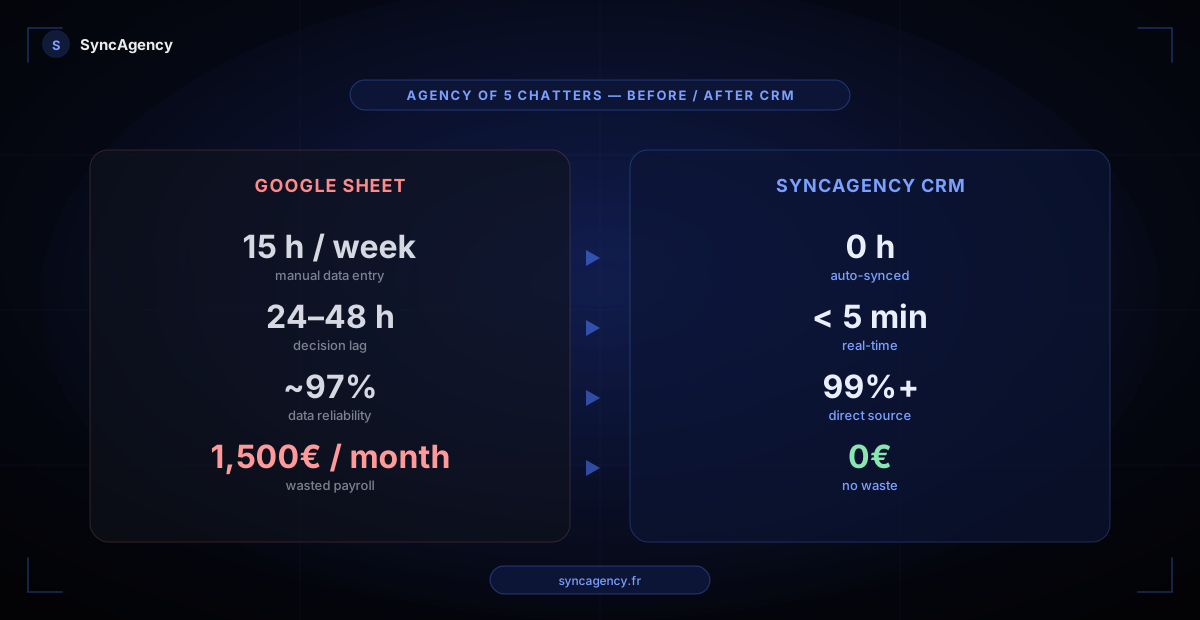
Now, imagine your agency with 5 chatters (which corresponds to 3-4 active models at cruising speed):
- 3h/week × 5 chatters = 15 hours/week lost to manual data entry
- 15h × 4 weeks = 60 hours/month of unproductive work
- 60h × 25€ average hourly cost = 1,500€/month of wasted payroll
1,500€/month is the cost of a complete CRM plan for 5 models. Except that instead of having a tool that works for you, you're paying your chatters to fill in cells.
And that's only the direct cost. The indirect cost, the sales missed during the hours spent on data entry, is impossible to quantify precisely, but it's very real. A chatter filling in their sheet is not chatting.
Section 2, The reliability problem
Manual data is fallible data. This is not a criticism of chatters, it's an intrinsic property of any human data entry. According to studies on enterprise data quality, the average error rate in manual spreadsheets is 2 to 5% of entries.
In an OFM agency with 50 transactions per day and 5 chatters, that represents 1 to 2.5 errors per day. Over a month, that's 30 to 75 erroneous entries. Some of these errors are benign (a typo on an amount). Others are critical:
- A fan marked "converted" when he isn't → you stop following up with him
- A chatter whose sales are under-reported → you undervalue them at payday
- An acquisition campaign whose results are mistracked → you invest in the wrong place
The problem isn't just the error itself. It's that you don't know which entries are erroneous. In an automated CRM, the data comes directly from the source. In a manual sheet, you trust the human chain, and that trust is, mathematically, insufficient as the agency grows.
Section 3, The scaling problem
Imagine you go from 3 to 10 models. Congratulations, that's the goal. But let's look at what that implies for your sheet:
- 3 models → 1 tab per model, 3 chatters, 1 manager can follow everything
- 10 models → 10 tabs, 8-10 chatters, cross-tab formulas, makeshift macros, circular reference errors
A spreadsheet's complexity doesn't scale with the team. It crushes it. A new chatter has to learn your personal nomenclature, understand your color coding, avoid overwriting existing formulas. Each onboarding takes 2 to 3 days of training just for the sheet, before even learning the job.
And when two chatters work on the same model (which happens often in an agency), simultaneous edit conflicts in Google Sheet create silent inconsistencies. You don't see them. The data contradicts itself. You make decisions on compromised data.
A CRM designed for OFM agencies natively handles multi-user, roles, and concurrent access. It's a fundamentally different architecture, not an evolution of the spreadsheet.
Section 4, The responsiveness problem
This is the least visible problem, but the one with the most direct impact on revenue.
Imagine one of your chatters has an exceptional day: +40% conversion on a model, thanks to a new script he tested. With Google Sheet, when do you see it? The next morning, when he has filled in the previous day's sheet. That's 24 to 48 hours after the fact.
Those 24-48 hours are that much time lost without:
- Sharing the new high-performing script with the other chatters
- Doubling down on that model while the momentum is there
- Identifying the fan segment that responded better in order to target it in mass DM
With a real-time CRM, this information is available immediately. You see it on the dashboard while the chatter is still performing. You can react within minutes, not the next day.
In the OFM business, fans have short mood cycles. A fan who's hot today can be cold tomorrow. Responsiveness isn't a luxury, it's a condition of performance.
Section 5, What a CRM concretely solves
A CRM designed for OFM agencies solves these four problems structurally, not cosmetically:
- Auto-tracking: sales, active conversations and conversion stats are recorded automatically from Telegram and the platforms. Zero manual entry.
- Real-time leaderboard: you see each chatter's performance to the minute. Top performers stand out instantly.
- Drill-down per model: you can zoom in on any model, see its stats by period, by chatter, by content type.
- 1-click report: the monthly report that used to take you 3 hours to prepare in the sheet is generated automatically. You spend that time analyzing, not aggregating.
Section 6, Figures: typical agency before/after CRM
Let's take a fictional but realistic agency: 5 active models, 3 chatters per model (15 chatters in total), 50,000€/month in PPV sales.
With Google Sheet (before CRM):
- 15 chatters × 3h/week of data entry = 45h/week wasted
- Information lag: 24-48h on every operational decision
- Data error rate: ~3% → 1,500€ of poorly informed decisions/month
- Manager's time to consolidate reports: 8h/week minimum
With SyncAgency (after CRM):
- Manual entry: 0h (data auto-synced from Telegram)
- Operational reaction time: less than 5 minutes
- Data reliability: 99%+ (direct source)
- Manager's time for reporting: less than 30 minutes/week
Estimated net result: between +8% and +15% in conversion over the first 3 months post-migration, solely thanks to responsiveness and data reliability. On 50,000€/month, that's between 4,000€ and 7,500€ in additional revenue every month.
At that level, the CRM costs nothing, it pays for itself out of the revenue it generates.